
Sacred architecture of Nashik and Trimbakeshwar
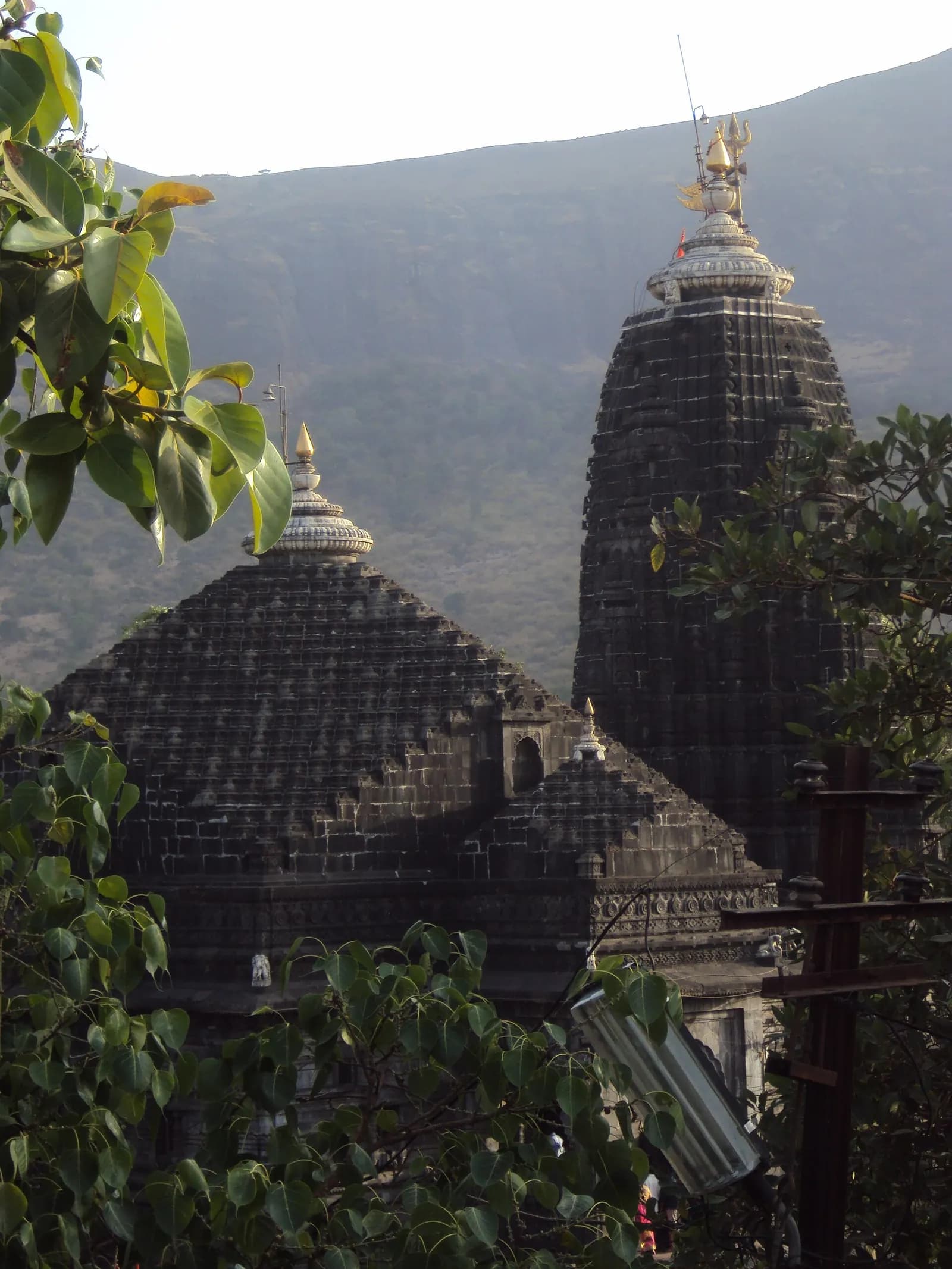
Built from the Deccan's black stone
Most of the great temples here are built from the dark basalt of the Deccan plateau. The stone is hard to carve but lasts for centuries, which is why the temples of Trimbakeshwar and Kalaram look so dark and solid.
Many of the temples you see today were built or rebuilt in the 18th century under Maratha rule, when the Peshwas and their nobles funded new shrines and ghats along the Godavari.
Reading a temple
Walk into almost any temple here and you pass the same sequence: an entrance hall (mandapa) where devotees gather, then the inner sanctum (garbhagriha) that holds the deity, crowned outside by a tall curving tower, the shikhara. The tower rises over the sanctum so the most sacred spot is also the highest point.
Trimbakeshwar's shikhara is covered with carved bands of figures and patterns, and the temple stands inside a stone-walled courtyard. Look up at the carving while you wait in the queue.
📅 Amrit Snan 2027: 2 Aug · 31 Aug · 11 Sept · 12 Sept · see the calendar
Ghats and kunds
The Kumbh happens on steps and in tanks as much as in temples. Ghats are flights of stone steps leading into the river, built so that thousands can reach the water safely. Ramkund in Nashik is the best known.
Kunds are sacred tanks. Kushavarta Kund in Trimbakeshwar is a square stone tank with steps on all sides and a covered walkway around it; it was rebuilt in its present form in the late 17th century and is where the Shaiva akhadas take their Amrit Snan.
Older still: the Pandavleni caves
On a hill at the edge of Nashik, the Pandavleni (Trirashmi) caves are a group of Buddhist rock-cut caves carved roughly two thousand years ago, with inscriptions from ancient dynasties. They show that this stretch of the Godavari was a centre of faith long before the temples you see today.
Note: the climb has many steps; go in the cooler morning.
Look for the details
Small things tell big stories: brass bells offered by devotees, lamp towers (deepmalas) lit on festival nights, carved door frames, and the worn steps of ghats polished by centuries of bare feet. Take a moment between rituals to notice them.
Ready to go? Turn this into a day plan.
✨ Plan thisKumbh Path explainers are written for general guidance. For official rules and timings, follow government notices.