
What is the Simhastha Kumbh, and why Nashik?
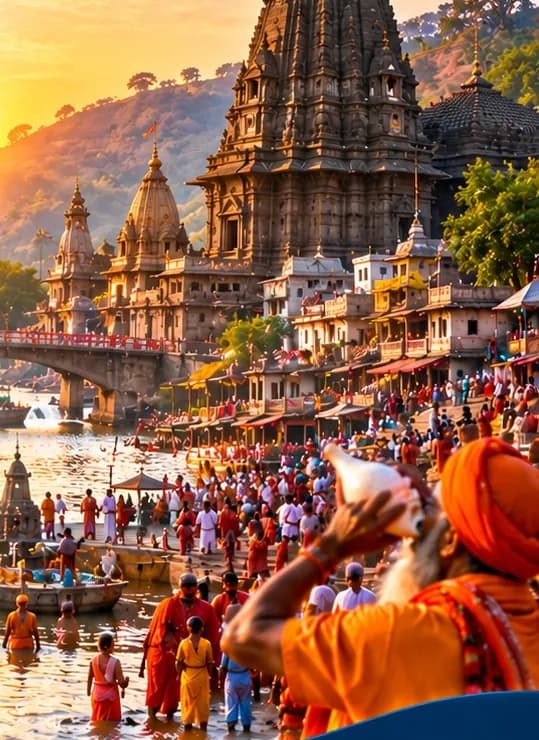
What is the Kumbh Mela?
The Kumbh Mela is one of the largest religious gatherings on earth. Millions of pilgrims, saints and families come together to bathe in a sacred river at an auspicious time, believing the dip washes away sins and brings spiritual merit.
The Kumbh rotates between four sacred river sites: Prayagraj on the Ganga, Yamuna and Saraswati, Haridwar on the Ganga, Ujjain on the Shipra, and Nashik–Trimbakeshwar on the Godavari. Each site hosts it roughly once every twelve years, timed by the positions of Jupiter, the Sun and the Moon.
In 2017 UNESCO listed the Kumbh Mela as an Intangible Cultural Heritage of Humanity, recognising it as a living tradition passed down for generations.
The story of the amrit
According to the Puranas, the gods and the demons once churned the cosmic ocean together, using Mount Mandara as the churning rod and the serpent Vasuki as the rope. Among the treasures that rose from the ocean was Dhanvantari, carrying a pot (kumbh) of amrit, the nectar of immortality.
A struggle broke out over the pot. Tradition holds that it lasted twelve divine days, equal to twelve human years, and that during the chase drops of amrit fell at four places on earth. Those four places are the four Kumbh sites, and the twelve-year cycle remembers the twelve days of the struggle.
📅 Amrit Snan 2027: 2 Aug · 31 Aug · 11 Sept · 12 Sept · see the calendar
Why is it called 'Simhastha'?
Simha means lion, the zodiac sign Leo. The Kumbh at Nashik–Trimbakeshwar is held when Jupiter (Guru) is in Leo, so it is called the Simhastha Kumbh. The Kumbh at Ujjain also falls when Jupiter is in Leo and is known as Simhastha too.
Because the timing follows the sky rather than a fixed calendar, the gap between two Nashik Kumbhs is close to, but not always exactly, twelve years. The previous Nashik Simhastha was held in 2015–16.
Why Nashik is sacred
Nashik is woven into the Ramayana. Lord Rama, Sita and Lakshmana are said to have spent part of their forest exile at Panchavati, the area around today's Ramkund, Kalaram Mandir and Sita Gufa. A popular tradition links the city's name to nasika, the nose of Shurpanakha, which Lakshmana cut off here.
Upstream, the Godavari rises on the Brahmagiri hill at Trimbakeshwar, home to one of the twelve Jyotirlingas of Lord Shiva. A river source, a Jyotirlinga and the land of the Ramayana together make this one of India's most important pilgrimage regions.
Two towns, one Kumbh
The Nashik Kumbh is unique because it is shared by two towns about 30 km apart. The Vaishnava akhadas, devoted to Vishnu and Rama, take their Amrit Snan at Ramkund in Nashik. The Shaiva akhadas, devoted to Shiva, bathe at Kushavarta Kund in Trimbakeshwar, where the Godavari is believed to reappear after rising on Brahmagiri.
For pilgrims this means two sets of crowds, two bathing places and two sets of travel plans. Decide early which town you will be in on each snan day.
Key dates for 2026–28
The Simhastha opens with the Dhwajarohan, the hoisting of the sacred flag, on 31 October 2026 at Ramkund and Trimbakeshwar, and continues until 24 July 2028.
The busiest days are the Amrit Snans of 2027: 2 August (Ashadh Somvati Amavasya), 31 August (Shravan Amavasya, the main snan), 11 September in Nashik and 12 September in Trimbakeshwar. Expect the biggest crowds, traffic restrictions and walking-only zones around these dates. See the Kumbh Path calendar for every date and reminders.
What it means for you
You do not need to be a scholar or a sadhu to take part. Families come for a single holy dip, elderly devotees for darshan, and many simply to feel the devotion of millions of people together.
Plan calmly: book stays early, choose quieter days if you are travelling with elders or children, make a family safety card, and follow official instructions on the day.
Ready to go? Turn this into a day plan.
✨ Plan thisKumbh Path explainers are written for general guidance. For official rules and timings, follow government notices.